Recent Popular Posts

Showing posts with label travelogue. Show all posts

August 16, 2010

Two weeks after

- Sanjeev

It's been a couple of weeks since we packed our bags from Bangalore and moved to Thulir in Sittlingi village, Dharmapuri. We have been to Thulir on a couple-of-week visits over the last three yrs, this time around we plan to stay for six months and see if we enjoy it enough to stay on.

We have settled into our new home: a cosy single room, a kitchen we have access to next door and a fenced area for Shifu to be outdoors at times.

I have started taking electronics classes for the youth. There is now a workshop that has come up next to Thulir and the youth are doing welding, electrification of the workshop. Others are working on the land, managing the kitchen, craft and a couple on electronics. They are doing these in much longer sessions than before.

Interested kids have taken slots times beyond their regular classes or in their free time. My slots span from 9:00 a.m. to 9:40 p.m. with sessions from 1 kid to 5 kids in a slot. I'm also taking math/electronics classes for the new batch. It's been fun to be able to give focussed attention and track how each child is doing. It's also great fun teaching children who are enthusiastic to learn. The amazing thing is that I have actually managed to find time to read the learning perl book and even complete the exercises :).

Ani has made a couple of vegetable beds and has planted radish, chili, bitter gourd, snake gourd, ridged gourd and some greens. She has also been putting the solar cooker that had been quite unused in Bangalore to active use given the sun here. Now we actually look forward to the sunny days for our breads and cakes. It has been raining in the last four days, around 2 cm cumulative so far (the kids measure this). This is nice too, especially for Shifu, who likes to play in the puddles the next day.

I have really enjoyed a few experiences like eating a ripe fruit off a Guava tree (I shared it with Ani), watching really low clouds on the hills surrounding this valley, finding time to do the things I have wanted to and spending more time with Ani and Shifu.

More pics ...

February 12, 2010

Research @ Thulir


We had two long visits to Thulir this year. One in Sep-Oct ‘09and one in Dec ‘09-Jan ‘10, each for 7-8 days each. Both the experiences were interesting in their own way.
Both times I worked mainly with the Basic Technology (BT) course that works with the 10th grade dropout children.
Before that, a bit on the follow up of the blog post a couple of yrs back, regarding working with Krishna and three children of the BT course in building LED based torches.
Lighting: A good part of the lighting at Thulir now runs off solar and is LED based. The kitchen, school rooms and Anu and Krishna’s home run off LED lights and these help the battery from the solar panels last the night in the more critical places. A professor of IIT helped the three children undergo further training and also gave them neat looking PCBs with the (constant current) circuit they use for a clean finish. Additionally, the street lights of the village were changed to LED lights and the same were put up in the hospital as well. This also helped the hospital move to Solar for its lighting needs. Both the 12-14 V of the battery and the inverter signal are routed in the wiring with the lighting now working without the need to turn on the inverter each time.
Children: One of the children has really taken to electronics intuitively, he is the village handyman when it comes to repair and installation of electrical/electronics. He manages the street lighting, needs of the hospital, etc. He is also employed at Thulir and is the second level of leadership having trained two batches of students in making torches and wall fixtures. He also reverse engineered a set of blinking lights and built it himself. The other two children continued their schooling and are in their 12th now. One of them visits Thulir regularly and helps the new trainees in things he is comfortable with primarily construction and farming
Trip I - Teaching
I tried to build on the fact that this batch of children (12 trainees and 5 youth now helping run Thulir) had some previous experience with working on LED based torches. I tried to introduce relating voltages and current by using measurements and also introduced looking at voltage drops across nodes of components and relating it to the voltage measured from a reference (gnd) node.
Also, we realized that the children had now worked with building circuits from scratch with the bread board and used the specific PCB for light making that did not require them to understand how to hook circuits up and could be done mechanically. This was fixed and the children did start understanding how a circuit is drawn and how it can be constructed on the board without soldering.
However, a big hurdle I encountered when using experimental methods there is need to be comfortable with understanding approximations and measurement accuracy. In real life things are not accurate a resistor that is supposed to be 1kohm (1000 ohms) varies +/-5% of its value and two resistors measured will not be the same value. Additionally, every meter has a measuring accuracy (that changes depending on the setting as well) and you need to be comfortable with these inaccuracies. Failing this, when a child expects to measure a 1 kohm resistor and encounters 980 ohms, it gets completely confused and looses trust in measurements. Additionally, though the children knew 1kohm=1000 ohms, they had difficulty in realizing that 0.98 kohms = 980 ohms… Unfortunately, I realized this issue quite late in the trip and the children had switched to their familiar mode of being able to do math mechanically without understanding it as they did in school. I was a little disappointed with what I was able to teach.
Trip II – Research
In the more recent trip I toned down the “teaching” and used a different approach of doing research with the kids to build something new. We decided that like we had LED torches we will use the dynamos and electrify the bicycles.
I had no idea what kind of voltages to expect from the dynamo and what kind of circuit we will need to build. Also, since many days the children were working on the land preparation (growing paddy), LED based reading lamps, etc I felt that perhaps being able to learn the research process and learning to look for details/accuracy of measurements would be something worth learning. It was great to have Ani, mom and Vinodh with me to be able to work with different groups in their experiments.
We found three dynamos (not all of them working) and created one group to work with each of the dynamos. They called themselves – Little Flower, Dil, Current (reminded me of “Electrical Engineers are always current” :)).
We started with observing what kind of voltage comes out of the dynamo at different speeds. This started with measurements with slow, medium, fast but had difficulty in reproducing the results. They took the suggestion of putting the information of speed in RPM (of their rotation of the pedal).
We also had group meetings that I explained were to keep each of the other groups know about what other groups had learnt, but to be honest, it was as much about keeping a tab on the kids :). I’m including some of the meeting minutes here…
Update meeting
1) Little flower – Dynamo was working fine
a)18 V @ 50 RPM,
b)41 V @ 124 RPM
2) Dil – Their dynamo was busted, they checked the dynamo by
a)Checking for a short in its two outputs. It was shorted.
b)Opening up the dynamo and checking the wire coming out of the dynamo. It was not shorted
c)Noticed that a plastic washer was broken. Substituted the broken washer with lifesaving electrical tape and presto they were good to go.
Reported values –
a)7 V @ 50 RPM
b)29 V @ 66 RPM
They were asked to check if the results above were reproducible.
3) Current - Dynamo was all rusted and didn’t make a good contact, cleaned up the dynamo
a)14.8 V @ 39 RPM
b)59 V @ 81 PRM
(With LOAD of 264 ohms)
a)15 V @ 45 RPM
b)49 V @ 91 RPM
(All measurements were made with the AC setting of the meter)
The range of voltage and the highest voltage were surprising. The circuits we had designed for the torches and what I build at work would have been fine for the low voltages, but have bust at the higher voltages. Not having been used to such voltages I was not sure if this was so high only because of no load or if it could actually drive some current. I looked at what could be used to load the dynamo to test how much power it could supply. Most components we had were for “electronics” the quarter watt resistors and these would have bust unless the resistor was large.
I took Perumal’s help in rummaging through the stock of things that were available. We found a few 33 ohm (1/2 W) resistors, we put a bunch of them in series. For 1/2W rating the current(i) needed to be such that i^2*33 less than 1/2 W i.e. less than 1/8 A. Normal 0 0 1 70 403 Columbia University 3 1 494 10.1316 <![endif]-->
--> This would have been achieved with 60 V with a resistance of (60*8 = 480 ohms). Perumal soldered the 8 we had freely available and I took a chance with the load (33*8 = 264 ohms). I warned everyone that the resistors would blow up if they got hot, these resistors snap and that they should just touch the load across the dynamo for a really short time (at “high” speeds). Nonetheless, it would be a quick test to know what kind of current the dynamo was capable of supplying with a load.
We tested the load with the group that was getting the highest output voltage (group Current reported with load). It was clear that the dynamo will be able to deliver the power we needed. It was more a question of how our circuit will survive the high voltage.
I wondered if the children understood the difference between AC and DC signals so in the meeting I asked what an AC signal was – they unanimously said “mains”, I asked them what a DC signal was they said “battery”. For what they had encountered so far this was true enough. I knew I was going to have some fun now :).
AC and DC
The next session I decided was a demo session. I made a small circuit with a diode, a large resistor (10k/20k) and a LED in one direction. I also put a parallel circuit of the same set in the opposite direction. I showed them the circuit since they were familiar with the components.
I asked them which LED will light up if I connected the battery one way and which would light up when I connect it the other way. They seemed a little amused at the simple question and answered quickly. We then played a little game and I hid the battery and only showed them the board with the LEDs and asked them which way I was connecting the diodes, I continued this till I was sure that every single one of them had the knowing smile that this was eazzzy.
We then went out to try it on the dynamo. We had a big group cluttered around the bicycle. I asked everyone to guess before we started pedaling, they all inspected my connections (apparently I’m considered a trickster) carefully and decided that the “positive” coming out of the dynamo will light the appropriate LED. We started pedaling and I will never forget the look on their faces, finally one of them unbelieving said, “anna, both are burning!”
I asked why this happens? Does it mean positive is there both sides and negative is there both sides? I asked them to think about it and offered a possible explanation for the same.
I also talked about “average” and I took an example of them going to the movies with each of them having different amount of money. We made some measurements with the multimeter in the DC mode to see that it gave no reading when measuring the dynamo output. (Can this bust the meter? We took the precaution of using Vinodh’s multi-meter that he had left behind.)
We also took the next course of action for the groups to built the circuit themselves and make observations and measurements.
Update meeting
1)Little flower – saw LEDs flash at low speeds
2)Dil made measurements with no load and LED load as
a.7 V-9V @ 40 RPM
b.21-29 V @ 140 RPM
LOAD
a.9V-11V @ 40 RPM
b.22-27 V @ 140 RPM
3)Current – saw LEDs flash at low speeds that went away at high speeds.
We talked about why this would happen, the first suggestion was that the current was higher and so the LEDs were not flashing. I wondered if that was really the case and also gave an explanation of speed of rotation and blinking and that if something blinked fast enough we don’t see it blink.
They felt that they had enough to go by and would build their own versions of the circuits.
Update meeting
1) Little flower – tried 2 LED+10k this was “dim”, voltage across the resistor was
a.11.2 V DC
b.35 V AC
(can anyone figure out why this would make sense in a half way rectified case?)
2) Dil – decided to try to fix another dynamo that was lying unwound, they tried varying the resistance from 10k, it worked sometimes (??)
3) Current – tried 5 LED+10k and could just not get it to light up.
Regulator
The LED lighting at Thulir is based of the 12 V battery (measures close to 14 V when fully charged). For this reason the 14 V is also routed to the rooms as well. When anything other than the lights need to be turned on the inverter needs to be turned on. The kids wanted to turn on the boom box at night without having to turn on the inverter. The boom box worked with 6 batteries and expected 9 V. In essence he needed a regulator from 12-14V-->9V.
Perumal had offered this problem in a short trip in June and we had tried built it with parts salvaged from old computer boards and it had not worked well. We tried this again with the following circuit. I had visited SP road since that trip and had bought some of the components like a power MOSFET IRF540N, zener diodes, capacitance, etc. The regulator is open loop, but we found the drop between loading and no load was 9.7V - 9.3V.
This worked quite well this time around and got me thinking of whether we could use the same regulator for higher voltages. I went online (there is a WLL based slow network) and found the datasheet for the FET. It is capable of working up to 100V! (and 33A!!). The solution was simple and incorporated ideas the children had used before :). The circuit used for the LEDs is the same constant current circuit used in torches. They can put as many of them as they like in parallel as dynamo is capable of providing the power.
We added the board for the bridge circuit and connected it to the 14V DC to test it. The capacitor burnt out.
I capacitor was rated for 100 V if connected properly. I that Perumal had flipped the circuit +/- coming from the bridge. Perumal has rarely made a mistake in building a board from a diagram and I was curious what happened. He grudgingly made the change, but something was bothering him and he kept saying something about perhaps not understanding diodes. On a bit of coaxing he finally said, you said that the triangle was the positive of the diode and the line was the negative of the diode. I admitted this again. Why then is it that you call a net that has two negative terminals of diodes positive and the net with two positive terminals of the diode as negative…this was interesting I had never even considered this could be a cause of confusion.
I explained to him how the current flows in one phase and gave him other examples of what he had seen and in essence how KVL works. This was nothing new as I had mentioned this to the class before as well, but somehow when he asked the question himself the answer seemed to have struck him. His eyes lit up and he said, now I get it and went on to explain the other cycle to me. I realized that the children understand circuits at a very different abstraction based on how they have encountered it. This perception works for what they have encountered and they don’t change it with theory or experiments I do. This abstraction gets corrected/modified every time they encounter something new they can’t explain. I took a mental note of introducing as many different applications and circuits so children can develop a feel that is generalized.
The next day was the fun demo of completing what we had set out to do as a hope and seeing the constant lighting whether the cycle ran slowly or fast was fun. The familiarity of the last circuit (of the touch) built by the children gave them some confidence to look at the other two boards (rectifier, regulator) and they didn’t seem to think it looked very complex J. I asked them to work with Perumal to build the rest themselves.
We also opened up a 3 W LED based fixture that had been given to Krishna, to my surprise it had the same FET we used (seems popular) and we found an alternative circuit that can also be used. The circuit has lesser components and the only purpose it serves is getting the lights to work. Well you live and learn, though the difference with our large number of components was that we were able to give out a constant voltage? The children asked if they could use it to charge their cellphones when they are traveling or when there is no power and how about FM receivers that work of 12 V?
I told them that I’ll check at work since the batteries require constant current, trickle charge, etc.
I checked at work with folks who design cellphone chargers and they felt that if a 9V or so can be supplied, the charging profile is taken care of in the phone itself.
One issue is that a lot of the power from the dynamo is wasted at higher speeds. The LED lights take very little power and perhaps do not pose an issue, but it does pose a problem of untapped effort of the user. A capacitor before the bridge could drop some of the voltage and in a dynamo since the frequency increases (or should) with voltage (due to higher speed) I wonder if this would do the trick of at least limiting the amount of wasted power. Suggestions??

April 25, 2007

Running

I finally kick started my running at ND. Om showed me the road that runs along the periphery and I decided run on the trail. The trail was about 2.5 km long and I did two loops. Boy was it tough! Was all out of breath at the end of it but felt good. Sweet pains as Gau calls them – love them! The next run I did 3 loops. It went much better and I really enjoyed being out around 6 in the morning. There was a nice chill and an amazing breeze. It had rained a couple of nights, so the soil was moist and the amazing earthy smell was in the air. I scared a bunch of hens along the way, got a few inches of red mud on my shoe since it had just rained and it felt weird each time I lifted my leg. I just couldn’t get the mud off and it kept accumulating more of it in the red mud patch. In all, it was a fun experience and got me started.

Building with compressed mud blocks

During ND’s nascent years, they had constructed mud huts with thatched roofs. I am not sure what the problem with the mud walls was but the thatched roofs were home to snakes. They have since made houses using compressed mud blocks. Mud (from the area) is mixed with a little cement (3% is what I remember but am not sure) and then compressed into blocks using a machine. The blocks are put together using some mud-clay plaster. They have not used any steel in making the beams to support the structure. The construction involves the usage of arches that take the load.

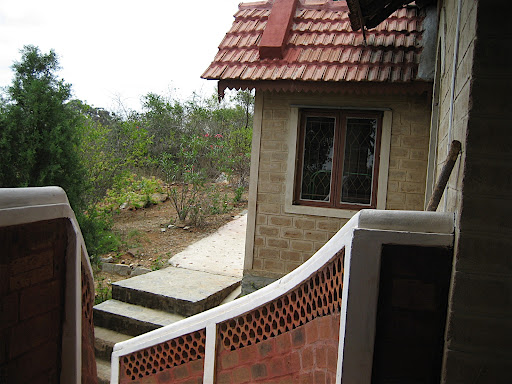
The roof is made of tiles (Mysore tiles I think they said) and about 4-6 tiles are replaced with glass tiles. Light streams in through these tiles and keeps the place very well lit. So there is no need for any artificial light during the day. A lot of light comes in through the windows as well. Same holds for breeze. There was some breeze at all times and I really didn’t miss not having a fan. And the nights were a little chilly too – natural A/C!

It is also much cheaper to build a place using mud blocks. The mud comes locally, so theres no transportation costs involved. Since it is being compressed, you dont need a kiln. You are saving on energy and hence costs. Besides all these advantages, the blocks themselves look beautiful and don’t need any paint.

Energy off the grid - Exploring some alternatives

Gobar Gas

They have about 20 heads of cattle now and their cowdung is used to run the gobar gas plant. Theirs has been functional for about 4 years and supplies the energy required for cooking. It is a fixed dome model (deenbandhu model) and the slurry drains off into one of two composting ponds. One of them was full and they would soon use it as manure.

They use about 65 kgs of cowdung everyday to create methane gas. I had no idea 20 heads of cattle produce that much, in fact more since they go grazing too, cowdung! Every morning at around 9, the people taking care of the cattle cart in the gobar and mix it in the tank with water. The dung needs to be mixed well. This is done manually and I also put my hand in. I was glad it didn’t feel dirty, though my hand had a distinctive gobar smell for the rest of the day, or maybe it was all in my head!

Solar energy

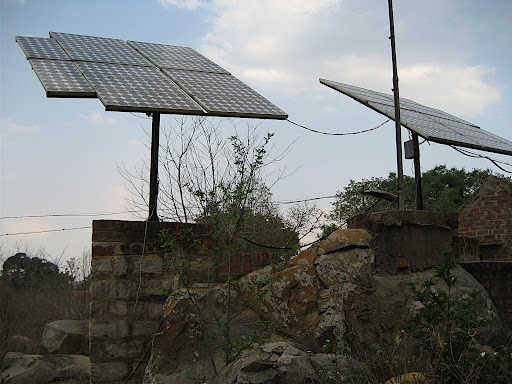
ND uses solar power for lighting, pumping water and for hot water. None of the buildings there have fans. They have been constructed in a manner that keeps them quite breezy and pleasant even in summer. Solar power is also used for the electric fence. They have had a bunch of panels for about 12 years now. They came with a10 year warranty and were supposed to work for 20 but they seem to be breaking down now. Om was a little disappointed with their performance given the high input costs and was talking about exploring more into using oil made from honge seeds for their energy needs.

Honge seeds

Oil extracted from honge seeds is used instead of diesel to provide energy. At ND, they run the generator on honge oil and it provides energy to the grinding machine that is part of their health foods unit. ND does not have many honge trees and they purchase the honge seeds from the nearby villages. The day I was leaving, the generator had broken down because the honge oil was too thick and had some drops of water. I am not sure if this is a regular feature or a one-off incident since I did not get a chance to talk to Om and Ananthu about it. These could be some problems associated with using honge oil.

Wind energy

ND currently has one windmill. It is a relatively new entrant into their experiments on alternate energy. Based on the wind velocity, it can generate up to 400W of power but on an average it produces about 150W. The power from this was used at Ananthu’s house for lighting, powering up a computer and an occasional use of a mixer. The entire unit cost about Rs 70,000 and was imported from China since India right now has good working models for commercial windmills but not for smaller ones like what they have installed. The investment seems to be high. I am not sure how this can be adopted extensively. Perhaps there are subsidies, I haven’t looked and didn’t ask Ananthu.

Dry composting toilets

The next couple of days, I watched Partapji spend time tending his garden and helped him plant some cotton seeds all along the fence. I even earned a quarter of a rupee for using his dry composting toilet. He has been trying to promote it among the people living in ND since currently most of the rooms there are equipped with flush toilets and he finds it incredulous that we waste gallons of good water to flush down our solid waste. Moreover septic tanks, the model used to deal with toilet wastes in many places, are a pain (Heres how they work). Someone needs to clean them eventually.

His composting toilet is by design mobile. It was a simple frame with a canvas covering the on 4 sides. He digs a pit about 2 feet deep and covers the humanure with mud each time, to avoid flies. Since it is so shallow, it should not contaminate any water sources. Once it is full, he leaves it alone for about 3 months and then plants a tree at the spot! If you are really looking for alternatives, so many surface I guess! Folks interested in learning more about dry composting toilets should read Joseph Jenkins The Humanure Handbook. It is available here.

Chat with Partapji

It was a rather cloudy afternoon and I didn’t want to miss out an opportunity to walk in the beautiful campus. So I headed out. A bunch of people were working on putting a fishing net on the drying platform so birds wouldn’t eat the grain that was put out to dry. I saw an older person with a flowing white beard working with them. I hadn’t seen him before. Soon Ananthu walked over and introduced me to him. He was Partap Aggarwal, another founding member. Some basic introductions and a mention of sustainable development ensued. Partapji immediately said there was nothing to development. All that mattered was for me to figure out what kind of life I would like to live. I had been expecting such a reaction from someone about the term development and here it was. It didn’t bother me. In fact, I couldn’t agree more with him. It was anyway an interesting way to start off a conversation. Soon I tagged along with Om, Ashwini and Partapji to check a point to dig a bore well. Om and Ashwini were working on clearing the area to provide some space for the machine and I started talking to Partapji.

He told me how this place was a dense forest only a few decades ago and how it is now very close to desertification. Left to him, I felt, he would have just let the place be with no human intervention. We got talking more about this and he said the current state was due to cultivation…organized farming. I had heard this opinion earlier from Bob Jensen but that occasion had not allowed further discussion. I wasn’t too happy to hear something negative about farming, with my current belief that small-scale farming is sustainable but was curious about his opinion on this matter. He simply said that the unsustainable cities we see and live in today are but a natural consequence of agriculture. Agriculture made it possible for hunter-gatherers to move towards hierarchical societies and cities are just a manifestation of this historical agricultural revolution. Our desire to control nature has resulted in us occupying enclosed spaces, cut off from nature. This has made us encourage highly unsustainable systems – systems that exploit nature, people and other forms of life.

So what happens next, I ask. Well, the system will collapse. All past civilizations have fallen and so will ours. The conversation was taking a turn towards the inevitable doomsday scenario, as I saw it, and I found myself resisting. He was calmly explaining why it was natural that such a cancerous system collapse. I said it did not sound optimistic. His response was that it could not be more optimistic than to hope that a tumor in your body collapses. Wouldn’t you want to get rid of the tumor as soon as possible, he asked me. I would rather hope we change how we live, I said. Which he immediately replied was exactly what he was talking about! Oh well, I guess so, I said but the whole inevitability is leaving a sense of despair in me. So I got a good pep talk.

P: There was nothing to be depressed about. The first thing is to realize that you are not running the world. That takes away most of the expectation and hence the depression.

A: That’s all alright, but if what I do does not matter in the larger scheme, why bother?

P: Just because you are an ordinary human being, like everyone else, it does not absolve you of responsibility. You need to work on doing the right thing, as you see it, but not be under any delusions that you are saving the world. Just the fact that you can even lead your life in the way you think it should be is important. You ought to feel privileged you are out visiting places and learning, whereas most people will never be able to do this.

A: Ok. But how do you then tackle forces like the SEZs?

P: Well, I don’t support them. And I think it is important for you to voice your opinion against them in whatever way you can. But don’t make your life a string of protests alone. You need to have something meaningful going on, something positive. If you are interested in living off the land, then that could be the source of your positive energy. Live on the land, try different sustainable ways of living. Provide people with an alternative so that when people listen to your protests and say ‘ok, what do you want us to do instead?’, you have something to show.

This got me thinking about how Bharathi Trust, Lok Samiti in Mehdiganj were all protesting different systems in the mainstream society but they were at the same time working on creating a society they want to live in. Bharathi Trust is doing this through its Resource Center. Lok Samiti has not only been fighting Coca Cola, they have also been working with the community in questioning certain social norms. They recently arranged group marriages for poor people who cant afford dowries, sending the message that one can find a partner in a simple, dignified manner.

Back to our chat. As long as we feel we need to control Nature, our efforts of small scale farming will not lead to much, he said. Only when we feel a part of Nature, will we able to listen and learn from her. So what does he think of natural farming. He said he had worked on it for 8 years at Rasulia and I was wondering where I had heard that before. Ah, he wrote the foreword for Fukuoka's One Straw Revolution! He answered in the positive and then the conversation turned towards his experience there. He believes that if you listen to Nature, you will not come up technologies that are unsustainable. You first need to realize that you are nothing. He mentioned Fukuoka’s spiritual experience that sent him on his quest of natural farming. The sun had set by then and we slowly walked back towards our rooms. It was a pleasure talking to this down-to-earth, 76 year old whose enthusiasm just rubs off on you.

Health Food Unit - why aren't whole grains the norm?

ND supplies many healthy, wholesome products through different outlets in Bangalore (Namdhari stores and homes of friends). They are trying to encourage the consumption of nutritious grains and millets that have been forgone by people in many parts of India.

The staple diet for most people was not white rice. Many rural communities ate millets like ragi and jowar and various varieties of rice that were not necessarily polished. The same holds for dals. Eating polished dals was not always the norm. People worked their digestive systems by feeding them wholesome grains. As Fukuoka says in his book One Straw Revolution, our bodies did all the work that current day mills do!

So how did we get fixated with white rice? The PDS (Public Distribution System) in India was instituted to provide subsidized food grains to people. And the reductionist thought that went into making it also decided that all people could eat white rice. People had access to cheap foodgrains and soon got used to polished, white rice. In Sittinlingi (where we spent time at Thulir), the community was quite cut off from mainstream society till it got a road to Salem. People used to eat a kind of gruel made from ragi along with sundal for their protein. Most of these were grown on their own farms. With the coming of the ration shop, they had access to cheap rice (Rs. 2 / kg currently) and hence had less reason to grow their own food. Slowly, there is a trend of growing cash crops and using the returns to buy food from the ration shop. It is the same case in the Baligi Kandriga region where Bharathi Trust has started the resource center. People have adopted cheaper, less nutritious diets. The situation is no different in Gumalapuram. I was chatting with some of the women who work in ND’s health food unit. While they still grow some ragi for their own consumption, they have all switched to white rice. Unpolished, red rice that ND dehusks and packages sells at Rs. 25 a kg – much more expensive than what the ration shop can provide.

Why don’t they sell unpolished rice at least? Ananthu told me about his experience in getting the white rice dehusked but not polished. The person he approached for this agreed to do it but said he would be charged a fee to which Ananthu agreed. He then saw farmers bringing in paddy to be polished and not getting charged at all. On enquiring about this seeming injustice, the mill owner responded saying the pharmaceutical companies would pay him much more for the rice bran. They make their vitamin tablets from it. So we eat polished rice with not much nutritional value and those who can afford it, get their daily dose of vitamins from vitamin pills!

Back to ND. Not many of the grains are grown at ND, the soil still has not recovered enough to support agriculture. They have grown some ragi in the past and will be planting some this season too. Some of the local farmers have started growing red rice organically and supplying it to ND. ND members go to the farms and work with the farmers about organic methods etc. They don’t actively campaign a switch to organic farming but support farmers who go organic by purchasing their produce. Most of the people who come to work at ND from the village nearby own some land. Over the years, after observing how ND has been working to grow food organically, some of them have started using lesser and lesser urea, which I thought was great. Such organic work takes its own time.

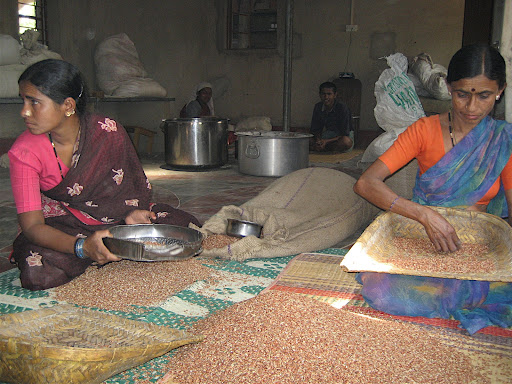
They make different products: whole wheat atta, ragi flour, sprouted dalia, sprouted suji, red rice, dry idli and dosa mixes using red rice (the idlis have an interesting purplish tinge), turmeric, chilli powder, jaggery, pickles, gheeless sweets, chyawanprash, honey, and lime juice concentrate are some that I remember. The food I ate at ND was tasty, wholesome and not oily. They served ragi muddais and red rice for lunch and different items were served for dinner and breakfast. They prepared a large quantity of the vegetable dish, very different from my other visits where I was served more grains. I later learnt of their health food ideology that stresses on the importance of a lot of veggies in your diet. In fact, according to Partapji, we would do just fine on fruits and veggies. Our bodies can’t really handle grain, hence we need to grind them, soak them, boil them etc in order to be able to eat them. I guess if that much work is to go in just to eat a particular kind of food, you don’t really have to eat it! Not sure I can give up my latest craze, set dosa but I agree about not needing so much grain.

The green canopy

Today, Navadarshanam is home to thousands of trees, most of which have taken root naturally. The first thing that was done when ND was started was to stop cattle from grazing on the land. In most places, forests were cleared making way for agriculture. Intensive agriculture soon led to loss of soil fertility and the lands were then used for grazing cattle. This leads to further degeneration of land since cattle just eat up saplings. Apparently sheep and goats create much of the problem, while cows are selective about what they eat and are thus not harmful to saplings. In this area, once agriculture failed, one of the international agencies (I forget which one) provided funds to the people to purchase livestock. The communities invested in sheep and goats and a lot of the region is bare due to this. Makes me think of Marx’s quote: the road to hell is paved with good intention!

Fencing off the land to grazing was not trivial. The local community did not understand their logic. They were not growing anything there and they certainly did not have any cattle (They did not want their own cattle damaging the vegetation. They purchased cattle after 6-7 years). So what were they doing with the land? It was tough and people sometimes cut off the fence to graze their cattle but the extent of grazing was much lesser and soon the land was covered with lantana bushes. This provided a protection cover for other saplings and soon different types of trees started growing there – the doing of birds. Over time, the lantana bushes committed suicide, as Ananthu put it! He is a strong believer in Nature’s patterns and was explaining how each year something different grows – it is almost like Nature knows what the land needs.

They might have somehow made their neighbors understand their philosophy about grazing, but when tuskers from the Thally reserve trampled through the land, nothing could be done. Saplings just died under their feet. This was when they decided to get an electrified fence that produces a pulse of very high voltage but small current and hence provides a shocking sensation that is not harmful. I was too chicken to touch it…maybe next time!

They have planted some fruit bearing trees but have taken the effort of not turning them into monoculture orchards. You would see guava, chickoo and mango all planted near each other since they argue that each of these trees require different nutrients and thus would not compete with each other.

Chat with Jyothi, Ananthu and Om

So what was I doing in ND? I told them a little about myself and my interest in sustainable living. The current scenario of liberalization, structural adjustments, SEZs are both causing small scale farming to be unviable and proceeding on further industrialization etc because small farming is unviable. So are there any alternatives - can we think small and work on sustainable initiatives that will help us grow without exploiting nature and other human beings? It seemed to me that ND was experimenting with such alternatives and I was there to learn about their efforts. This led to talking about how ND was started.

Some of the folks I met at ND - Jyothi, Ananthu, Om and Partap, are founding members. Jyothi and Ananthu were based in Delhi in the 70s and 80s. Ananthu, an engineer worked for a few years in the corporate world and then moved to the Gandhi Peace Foundation. Jyothi was a sociologist by training and taught at IIT Delhi. In Delhi, they started a study group where they analyzed the current system and discussed alternatives. Through this group, they came in touch with others with similar interests. Partap Aggarwal had been experimenting with alternatives for a few decades. An anthropologist by training, he taught for a few years at Colgate University before moving to India. In India, among other things, he worked for 8 years at Rasulia, experimenting with natural farming or ‘rishi kheti’. Jyothi, Ananthu, Om and Partap met at Atheetha Ashram (from what I gathered, their spiritual camp in those days) and decided to work together towards seeking an alternative to the unsustainable urban life. About 105 acres of land was identified near the Anekal area and the Navadarshanam Trust established. The land, that had been a thick forest 80 years ago, had degenerated due to deforestation for timber, intensive agriculture and finally unchecked grazing. They decided to work with the land and try and revitalize it with the larger spiritual goal of inner quest.

They function on an ideology of wholeness. At both the level of the body and the mind, each of us is an individual, separate from the other. It is at the level of life that one realizes the oneness with all beings. Such a connection, they believe, would lead to new technologies that would provide us with better lives and not exploit nature and hence other human beings.

While most of the founding members wanted to stay at ND and work together, many of them were unable to do so due to different commitments. Jyothi and Ananthu, who had by then moved to Whitefield, near Bangalore, became the coordinators and started managing the day-to-day activities. A couple of things tied them all together: their spiritual growth and Fukuoka’s One Straw Revolution. They wanted to practice natural farming and most of them had no idea how to go about doing it. Partap had worked on it at Rasulia but he was unable to spend much time at ND. They had a very resourceful person in Sunny who put his heart into it but for some reason it didn’t work. It could be that the land needed more time to heal or as Partapji mentioned at a later conversation, that there was a search for immediate results and natural farming requires one to have a different mindset. They have had success with the fruit trees though. They then started the health foods initiative to work towards self-sustenance. Looking back, they say that it was a learning experience in adapting to the situation while functioning within their ideological framework.

On my way to Navadarshanam

I started out for Navadarshanam around 10 AM on a Monday morning and it didn’t take me long to realize what a blunder that was! I was hoping to ride the bus to Majestic (the bus terminal in Blore) and then catch a bus to Anekal. There was no way I could squeeze in with my two bags, well, at least I didn’t want to try it. Found an auto after some time and he told me it was much easier to take the bus to Anekal from the Silkboard – much closer. The bus to Anekal came along pretty soon and in about 50 minutes, we reached Anekal. I took an auto from there to Gumalapuram, where Navadarshanam (ND) is located.

I had heard about ND from Anita B and then from some Asha Bangalore volunteers. In fact, when I asked Gaurav’s mom where to get the awesome dalia I had at their place, she took me to Namdharis. I was very surprised to see it was a Navadarshanam product. They supply a few wholesome products like red rice, sprouted dalia and ragi to the Namdhari chain of stores in Bangalore. Their website has quite some information - they seemed to be trying out some alternatives in housing, energy and living and I got curious. I called ND about staying there for 4-5 days and Jyothi said it wouldn’t be a problem.

I reached ND around 1:30 and there were about 10-12 people having their lunch. I joined them and kicked off my stay with ragi muddai and some tasty sauce. Jyothi and Ananthu had gone to Blore and would only return at night. I was taken to my room in Manjari and I spent the entire afternoon in the balcony reading. The balcony overlooks an expanse of greenery and there’s always a breeze blowing. Around 5 in the evening, it got very pleasant and I went out for a walk. The ND trust looks after about 105 acres of land and I stumbled upon various paths. I was finally pointed to the periphery road, which is 2.5 – 3 km long. I walked some distance, deciding to put my running shoes to use here the next morning. Watched a beautiful sunset and walked back for dinner. Just as I was finishing my dinner, Om, Ananthu and Jyothi got there. After some introductions, we decided to get together the next morning to talk about what I was doing there.

March 08, 2007


The Thulir Experience
About Sittilingi
About Anu and Krishna
How we landed at Thulir
Porting Sugarcane
Interacting with children in technology course
Home schooled children
First evening class: Getting children to make their own puzzles
Learning Circuits (LC) I: Let there be (some) light
An early morning visitor
They were not kidding
LC II: A different approach
LC III: Taking stock & roofing
LC III(a) My homework: making a torch
LC IV: Checking components
Group Discussion: Fear
LC V : Building boards and getting to know the boys better
LC VI: Testing and fixing
Pictures from Thulir
Thulir Blog

How we landed at Thulir

How we landed at Thulir

We heard about Anu and Krishna through Asha. They are both Asha fellows and we learnt more about what they were doing on a conference call in which Krishna spoke. We were interested not only in their work in alternate education but also in their trying to lead a more organic life - Krishna had briefly mentioned solar panels and dry composting toilets and we wanted to learn more.

We had moved to India with an idea of spending time with a few grassroots efforts. Thulir happened almost suddenly. We had a bunch of weddings to attend and after a couple of weddings and a few trips to different urban spaces; we were starting to get restless. We then contacted Anu and Krishna to check if they would be willing to have us over for about 10 days. They quickly figured out where to put us up and in a few days we were traveling to Sittilingi.

Getting to Sittlingi
Feb 12

We started from Chennai at 4:00 am, so we could reach Sittilingi by 2:00pm. The plan was to get to Tiruvannamalai in time to catch the 10:30 a.m. bus that goes all the way to Sittilingi. The only other bus was at 3:30 p.m. so we had no intention of missing this bus J. We first went to Kottapatti (CMBT bus terminal) to catch the out-station bus (platform 6) and reached by 9:00 a.m. with plenty of time to spare for our connecting bus. We had iddli, dosa and coffee at Ashoka Hotel and reached Sittlingi by 2:00 p.m. We got of at the Tribal Health Center (called the Sittlingi Hospital stop). We mentioned Thulir and were led to the center of the hospital from where we were driven a few km to Tulir. Krishna was at the gate to greet us. Funny as it was, the call taxi to take us to Kottapatti cost us more than breakfast and the rest of the journey.

About Anu and Krishna

History: Anu and Krishna are both architects and have worked for a long time in constructing houses in rural areas. We enjoyed talking to them about how they got interested in this field. 1988 was declared as the year of homes for the homeless (by the UN I think) and the theme for the annual architects meet was decided to be the same topic in 1987, in order to prepare for the main conference the next year. This exposed many of the students to the problems faced in the slum and rural areas and encouraged them to think about constructing houses using local materials etc. Anu and Krishna were deeply influenced by this conference and since then, they have been working with different NGOs, first with Gandhigram near Madurai and then with a group near Gudalur. Gandhigram has many cottage industries. They both worked on mud houses there. At Gudalur, they worked on teaching the tribals construction methods. Their goal was to make them self-reliant in some skills and to eventually empower the tribals so that their (Anu and Krishna) presence would not be needed. They worked with children who had dropped out of school and later, also spent time teaching younger children. They trainees were able to do estimating, draw out plans and analyze costs. How did they come to be at Sittilingi? Anu and Krishna’s friends, Regi and Lalita, doctors by profession, decided to move here in 1992 – 1993 since the place had poor human development statistics. They set up a hospital, called Tribal Health Initiative. Anu and Krishna were interested in working with the children in this area. After a year of travel to various such efforts in India, they moved to Sittilingi in 2003 - 2004 and Thulir was started.

About Sittilingi - Anita

Sittilingi is located in a beautiful valley, surrounded by hills on all the four sides. It is one of the villages in the valley and the population of the valley is about 10,000. The place was difficult to access till about 6 months back when a road was laid connecting it to Salem. Most of the people native to Sittilingi belong to the Lambadi or the Malayali tribes, the latter name derived since the valley is surrounded on all sides by hills, ie, “malai” in Tamil. Most of the people own some land, which is because of their tribal chieftain who handed over land pattas to the natives and registered them as Tribals when Sittilingi was made part of India. The main occupation here is agriculture. Until about 2 years back, people practiced subsistence agriculture. People grew their own food and perhaps the excess was sold in Kottapatti, the nearest market and Salem. Also the methods used were sustainable compared to mainstream agriculture – organic methods were employed and people did not engage in unseasonal irrigation. Only recently, with the connection to Salem and thus a market, they have been growing more cash crops and using chemical pesticides and fertilizer. Sugar cane is one of the cash crops grown here - we saw a few tractor-loads of it leaving for the market. They also grow turmeric and cotton. They also grow industrial tapioca which industries use for starch. Most of the tribals grow tapioca and turmeric. The tribals who have dug wells and use pumps are the ones growing sugarcane, the rest do not due to the amount of water sugarcane requires. Sittilingi does not have any active market. We wanted to purchase some fruits but all we could find in a makeshift shop cum rudimentary hotel were a bunch of bananas, whereas one would find local farms growing papayas and guavas!