Recent Popular Posts

April 23, 2014

I wonder...(and 6th graders pics and survey)

The surveys including and the one I did with the 6th graders (below) made me wonder about various aspects of my work with children. The survey for 6th grade is embedded below for those interested.

Pree said that the one thing she learnt well this year was listening. Listening to each other (and peer learning) was an important aspect of our classroom environment, but for Pree to notice this as her best learning for the year felt special. I wonder if I would have emphasized listening as something I work on, if she had not reminded me.


My best classes have been when I have been happy and calm. When some children say - a teacher should teach well and offer no explanation, I wonder if they are trying to refer to what they want us to be, rather than what they want us to do.

A very large number of children seem to care about how the teacher feels about them (and not what their own classmates think of them). I wonder if I utilize this to always help them grow.

Almost all the children I work with enjoy math, I wonder if they always enjoyed Math or our definition of what constitutes Math makes them feel this way.

I saw the grit in children I worked intensively with grow significantly over the year. I wonder if I can figure out what I did right to achieve this.


I went to the furthest village where the children come from to IA school and met their guardians. I wonder, if I should step in for the 6th grader whose grand-mom is going to send her to the local government school because the she feels she will no longer be able to afford the child's bus fare.

Background of work with 6th graders @ Udavi:
@Udavi my work with the 10th graders in the first term enabled me to see that gaps in learning of abstract concepts in 6th and 7th grade fail to get filled. I then focused on these two grades in the other two terms. 
The 6th graders had a lot more freedom and flexibility in the classroom and I tapped this to work with games - short mental board games, pizza games, (dis-)entanglement puzzles. Moving towards stories of multiplication and its equivalent two division stories, integers, fractions, decimals, areas with geoboard, cartesian divers, introduction to algebra and many puzzles. 
I worked closely with the class teacher Sudhir and we worked a fair bit on classroom environment where children could listen to each other e.g. multiplication stories and convert it to division stories. We were also able to wait out conversations to subside on their own when the children realized that the class was waiting for them.


Survey:

April 20, 2014

Survey of children in 7th Grade @ Udavi

At Udavi in the first term I had worked with a few kids from 7th grade in sort of remedial classes using teaching aids. In the second and third term I took the entire class (with the teacher observing). I had two classes (1-1/2 hrs each) a week in the second term and three a week in the third. This was that I initially relied on class room delivery - use of teaching aids - densiel blocks, geo-boards, pizza party. Slowly as I got more comfortable not sticking to script, we worked on basics stories to understand multiplication and division and extended it to fractions, puzzles, algebra, practical geometry, geogebra (connecting algebra and geometry). We were able to do one project on common mistakes children make in fractions, algebra, decimals using the computer and incorporate some electronics classes for interested students on LEDs, measurements and building lemon batteries.

At the end of the year, I wanted to do a survey with children on aspects that would help me understand how children view themselves and their learning and also take inputs to improve the classes for next year students. I took some inputs from a survey conducted by sri.com to review usage of Khan academy resources in Math and made it much crisper.

I took the surveys through one-on-one conversations to translate the questions into Tamil, if required, and get individual inputs. I zeroed in on the exam time being the best time to get time to talk to children without them being biased by other children's inputs. One issue was that some of the children were tense or  worried about the exam, however, they had made their own examination and I expected this to be lower. 

Here is an album of the children taking the examination:


Udavi School 7th Grade Math Final Examination

The first question, 'how do you feel?', also gave the children an outlet for their emotions. A child who had lost her grandparent a couple of days back was sad and expressing her sadness helped her notice it and feel listened to, after a couple of minutes she felt ready to participate in the survey.

I asked for a couple of things they had learnt well this year and areas like making an abstract equation real with a story, algebra and its link to geometry, fractions and puzzles figured often in the list.  Of the 17 children, 12 said that their goal in the next grade was understanding and learning new things, 5 felt that their priority was getting good marks.

During my very first interview I added a question about what a child expected from his/her teacher because this is how the first child interpreted the next question. It seemed something she wanted to talk about, I thought it would be interesting to see what children had in mind. A teacher who is friendly, understanding, provides clarity and introduces something new constructed this image.One reply was, they should be like me. This kid likes to have a good laugh and I looked up from my laptop to see if he was kidding, but his eyes had no humor just earnestness. Ok, sweet.


9 children felt it mattered to them what the teacher thought of them and primarily some of those said they cared about what other students thought of them.

12 kids said they liked math, 4 others said they like it at times. One child felt that he doesn't enjoy math because he only seems to enjoy it when its extremely easy. Another child felt that he needs to feel challenged to enjoy math.

I'm not sure how children interpreted - do you learn easily? The children who struggle in class can see it and the ones who are doing well know it too, but for the rest I am unable to process any trends.


The replies on grit - can you continue to work when things get tough or boring suggested that most of the children who struggle in the class in Math said it was difficult for them to keep going when it got tough or boring. This is in line with my current understanding of one of the skills that we need to develop in children.

Suggestions on what could be added or changed in class included field trips, more projects and puzzles, more science, games (I primarily did this with 6th graders), more electronics classes. A few children wanted to go beyond peer learning and teach the 6th/5th graders what they learnt. 
When some of the children realized that I was not planning to continue teaching them in 8th grade they went into denial. One suggested that the 6th grade teacher should graduate to 7th grade and I can continue with them. Another used logic saying that the survey of how to do things better constituted a contract to continue and implement it next year. One of them resigned and just wanted me to be around in the breaks so he could ask me something he didn't understand in class.
Three children brought up the need for daily/more classes. Having seen the improvement at Isai Ambalm with daily classes I plan to increase it to 4/5 classes a week.

The survey (minus children names) is embedded below and available here.

April 19, 2014

Conversations for completion of the schooling year at Isai Ambalam school

From June last year I have been working with five 7th graders (and one 6th grader). It was a small classroom and I tried to merge math and science in the first term, created a multi-grade classroom by adding 5 fifth graders in the second term and encouraged the 7th graders to get into self learning in the third term (I felt their basics were sound) and also made the newton's cradle, wind chimes and actively worked with geogebra with them. 

The school only goes up to 7th grade and its quite likely that I may not see the graduating kids .
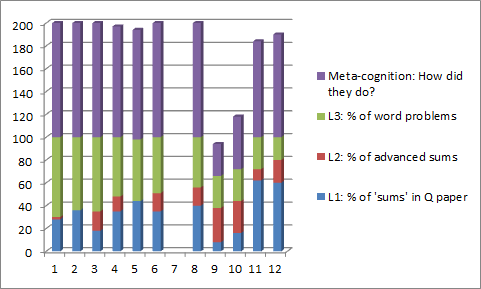
I extended the idea of self prepared papers from Udavi to Isai Ambalam school.  The 7th grades each prepared impressive question papers with over 60% of the questions being word problems for fractions, interpretation of word problems as algebraic expressions, writing stories for algebraic expressions, graphs representing algebraic expressions, puzzles, pie charts. What really brought a smile to my face was that they could handle the beast they created. Their meta cognition has been improving over the year, but for it to actually culminate with all six of them being able to do it to such a high degree (all over 96) was a nice farewell gift. 

The examination seems the great time to talk to children one-on-one and get feedback from them as it avoid biasing their replies based on what other kids told them. The one drawback of anxiety of an examination was generally lower as the kids made their own examinations.

I let them get their emotions out by asking how they felt and after the reply the kids seem to ease out to talk about what they learnt well, what their aim when they enter their next year math class, what they expect from a teacher, whether it is important what their teacher or friends feel about them, whether they enjoy math, if they learn easily, if they are able to be persistent and their inputs on what we could do new and different for the next class.

In the 7th grade, 5/6 children felt they learnt algebra well. For the 5th graders a big thing was fraction addition. 9/11 talked about their aim in the next grade being learning new things. One child in 5th grade talked about how she wanted not only to learn what was there in 6th, but also things from 7th like she did this year. 9/11 felt what the teacher thought of them was important but on 3/11 felt what their fellow students think about them is important. Only 1/11 children put riders on enjoying math :). 

Then it got interesting, we talked about whether they learn easily, many children interpreted it a little broader and talked about how they learn. Most were consistent with my observations in the classroom. Next came persistence and grit as it is claimed that it is directly related to how a child does in math. But, we talked about it in terms of a project. It doesn't appear that younger children have a clear handle on that.

The incoming 5th graders is a huge class (19 children) and the challenge next year is going to be very different...but for now I enjoy the small pleasures of life :). I'm embedding the detailed feedback below. Its also available at this link. I have removed the names of the children, but left in how they did (for anyone who wants to co-relate what they said with what they did).


April 17, 2014

Children building a Speedometer/odometer

For Monday morning every week I have been working with few four kids from Deepanam on electronics and Arduino based projects. These kids were up for bicycling to the electronics lab in Udavi.

After tinkering around a few things we finally decided to build a speedometer for the cycles. One and a half hours a week was not getting us there and I let them access the lab for 1-1/2 hrs more as I merged the class with 6th grade electronics-mathematics classes in the lab.

For the speedometer the first work was on the LCD display. We first got a 16x2 that got burnt because the kids wired it one pin off and switched supply and ground. We then used a 16x1 which actually needs to be accessed as a 8x2 and eventually the next order of 16x2 came in. The lesson of the switched supply as well learnt as the displays have been hooked on and off tens of times without loosing another display.

We planned to measure the rotations of the cycle using a reed switch. (A reed switch has two metal wires placed in such a way that if a magnet gets close it would close the connections).
Unfortunately the experience with the reed switch was comic almost approaching tragic proportions. We only had a couple of appropriate reed switches. I had a couple from Bangalore, but once we got the first working (perhaps) it looked good enough to be stolen off the bike. The second was burned out when both ends of the reed switches were connected between power and ground. We soldered a couple of really delicate reed switches and put them in ball pen refill for protection. Two of those broke off because the magnet was too strong and the reed switch wire just kicked off its glass body to join the magnet. We finally seem to have one that has lasted a couple of weeks, but its still the weak link.

We calibrated the rotations by printing the frequency measured based off the switch with a multimeter measuring Hz. We also realized that using pin13 for reading was convenient as it showed when the switch got close to the magnet with the built in LED on the board.


For the software, a basic polling routine worked fine for reading the reed switch and we didn't encounter a limit of the speed of the routing even when we were spinning really fast (or tricking it with a jitter around where the magnet activates the reed switch). Using the radius of the cycle both the speed and the distance are reported. We made some optimizations to avoid rewriting the fixed letters.


April 16, 2014

Math does not understand life...

Some of the stories children made for two unknowns (linear algebra) were not making sense to them. I decided help them by making things worse and pointing out:
1) Solutions of the two variable was not just the points corresponding to integers on the line, but all points of the line i.e not just of whole mangoes/chocolates, but a continuous line of ml of a liquid e.g. for
x+y=10
then you could talk about 10 ml of oil being divided between two test tubes with 5.2 ml and 4.8 ml. Then of course, someone brought up that even a mango can be cut. 
The discussion led to whether counting mangoes in numbers was even a good story as it assumes that all mangoes are exactly the same and perhaps we should be referring to mangoes in a more measurable way like weight.
2) In the story where Var and her sister share 10 chocolates we were only thinking about both numbers being positive, but the straight line extends to solutions in which one number is actually negative. We talked about how we could possibly extend the story for this to make sense - It was Sha's b'day and he gave 10 sweets to everyone in the class. Var being a considerate sister gave all her 10 sweets to her sister (who is in the other class) and even went out of her way and borrowed 2 sweets from Ezu. Now her sister had 12 sweets and Ezu would come tomorrow and ask Var for sweets.

We talked about Math being abstract and not understanding life and that we needs to understand the context of real life to meaningfully interpret results obtained by using Math.

I came across this interesting quote from Einstein after the class: 
"As far as the laws of mathematics refer to reality, they are not certain, as far as they are certain, they do not refer to reality."