Recent Popular Posts

Showing posts with label udavi. Show all posts

March 12, 2017

Change in culture

Four years back when I moved to Auroville I would post one or two puzzles a week on the school notice board at Udavi. I had announced them in the classes I taught and there were always two children U and D in the school (in 10th grade) who would attempt to answer the puzzles. They would discuss the puzzles among themselves and often submit a solution to the puzzles. Sometimes they would have doubts and come and explain their logic to me and ask me to find a flaw.
I did some visual puzzles with arranging match sticks and these some of the 6th graders were interested in, but by and large, I got one or two solutions for the puzzles with barely any discussion about the puzzles.

Last week Naveen took up the exercise of putting up a puzzle a week in STEM Land. There has been quite some discussion about the puzzle - the 9th graders applying algebra to solve it and the younger attempting to do it without algebra. I even noticed a volunteer who has come to learn STEM has been attempting to solve it. 

It remains to be seen how much of this buzz translates to children taking the initiative to submit their queries, especially as we have not marked any prizes for their submissions. Nonetheless, I can see a change in culture, of attempting puzzles, that was missing in the children before.

January 16, 2017

Training of Savarayalu Nayagar Government Girls High School @ STEM Land

A note regarding the teachers workshop last week with Savarayalu Government Girls High School. Their principal Hemavathi had visited STEM Land with 10 of her children and (the computer instructor from KV Jipmer) a few weeks back and spent the day here interacting with the children and seeing their work.

I found the girls were very thoughtful and identified three areas that they wanted to add in their school - fun, challenges like puzzles, creativity in doing projects from their experience at STEM Land.

Hemavathi is the general secetary of the Pondicherry Science Forum and a very respected teacher trainer in the government. She was thrilled with the motivation and self-direction of the children who she saw were able to work independently and effectively. In her visitor note she wrote that STEM land gives her hope.

She put this in action and this week she organized all her 20 odd teachers from different subject areas including languages, Social, Sports and music and of course Math and Science to come during the holiday to STEM Land for training. We prepared a 4 hrs module on teacher training including use of stewardship tools that look choice of working from possibility and fears and doing things differently. Initially the teachers were not sure why we were introducing the stewardship tools that we said benefited us as teachers and are useful irrespective of the area you are working on, however, they were able to put this in practice the very next session when we jumped into getting teachers who had been fearful of computers for 30-40 yrs to program with Scratch. 
The teachers were very engaged and delayed their lunch by an hour and a half to work. They also interacted with a few children during the breaks. Three 8 grade children (Punidhivel, Kabilan and Vignesh) and Yuvaraj (9th grade) also joined the teachers and it was wonderful to see the teachers open to learn from the children. Thanks Anand and Geetha for responding to the children's request and letting them express themselves, it made a difference.

The reflections at the end of the day from the teachers gave us hope of changes in attitudes both towards technology and how they work with children. One of the teachers talked about how she and other teachers had assumed that being strict and making children sit straight and control their movement was making children learn, but now she saw what the body language of a children engaged in what they were learning looked like and would like to see that in her children. She also felt that she could have learnt a lot more if she had not grown up in a culture of fear of failure and that she will be bold in her actions for the benefit of children. Another teacher mentioned how she has always been externalizing actions (as school and we) and she will now take responsibility for her work as she sees its for her growth. An elderly teacher remarked that he had seen many schools both high class for well off children and poor schools. But, Udavi was special, its a high class school for children who are from poor families.

Given the positive response of the teachers we are continuing the engagement with them with a visit to their school tomorrow. Hope our work here makes the lives of the 450 girls and the 20 teachers in Savarayalu more meaningful and joyful.

(for STEM Land team - Arun, Bala, Muthu, Naveen, Pratap, Ranjini, Sundar, Sanjeev, Vaidegi)

November 30, 2015

Stroll through STEM Land

I made a 3 minute video of a stroll through STEM Land on a Sat. We (Aura Auro team) are together at the same time with multiple classes and a few children from around who join us. Here is the video:


A few notes:
- The display for STEM Land was made last week by a few children. It switches between a 5  sets of ways of how STEM Land is displayed. The children soldered the board together programmed an arduino to switch between these (with help from Naveen). Here is a blog post with more about this.
- We recently added dobble, blockus and another abalone to STEM Land. Blokus is another great strategy game and dobble is excellent for observation with different scaling. These additions are popular and extremely good in brain twisting skills. 
(We also got bounce off and jungle speed which are also very popular though I am not as convinced about their utility to learning :).)
- Children have been working quite a bit on Alice a 3D programming environment. This allows children to stretch the programming they were introduced to in scratch with a 2D stage to a 3D world. Here is a note on a game that Rati is creating.
- Blender has also picked up and few children children have learnt more or less on their own. Vaidegi also started putting the 3D printer in action first with things available online and then with learning blender herself this has added the idea of being able to create what you make in blender. The implicit mathematics and visualizing in modeling 3D images is excellent. With the printer you couple this with what can actually be made nicely.
- The 'fan' is a salvaged (thanks Lata) and the children added an external battery adapter (since the one inside had rusted) and Puni is explaining how he noticed that it acts more as an exhaust picking up things rather than what he expected of pushing things away.
- One group of students have become quite good at putting together mindstorm robots. The first one took them 2 weeks. This is their fifth robot and it just took them 2 days to put together. Here is a link with a snake robot in action.
- We have started salvaging old boards that I had around to get components we can use elsewhere and started a fix it lab. We fixed our first phone...yay, more on this later.
- A few Isai Ambalam children join us on Sat since its their day off and so do a few children from Auroville.

Playing, tinkering, making and learning is alive in STEM Land.

November 10, 2015

Experiences at STEM Land...

A few recent experiences at STEM Land that touched me...


- I have been touched how elder and younger children with similar interest are willing to work together as equals. How open elder children are to learn from younger children who have developed an expertise at something.
- We didn't spend a single rupee on labor to set up STEM Land. A big we (Aura Auro, our friends, volunteers and the children) did it ourselves.


- I had decided that I was going to let STEM Land self organize. One day some younger children came to me and told me that a couple of elder children had taken their laptops. I told them to work it out among themselves. About 10 mins later I had opportunity to work with the elder children and I enquired what happened. The elder children without batting an eyelid said that STEM Land is a place of work and they only took the laptops from two children who were playing computer games and not working seriously.


- We started working with the 9th grade girls only this term and in the beginning they would only stay in the games, materials room and not explore the technology room. This week I had a couple of girls working hard to create a story using programming in a 3-D environment and connect their mathematics to what they wanted to accomplish. Another group has been working on soldering a display for STEM Land with N.


- A few Isai Ambalam (the other school I work with) children come to STEM Land on Sat (their day off). They just felt at home and the Udavi children took care of them as their own when they are here for the whole day. A couple of Auroville children have started coming to STEM Land once a week and were unfamiliar with the programming environment and some Udavi children sat next to them and worked and helped them when they were stuck and I was only called once for help during two sessions of 1-1/2 hrs that they worked here.

- N who has completed his undergrad in EE wanted to volunteer at STEM Land I asked him not to worry about teaching children and just focus on using STEM Land facilities for his own growth. When he started working he realized that children could do many more things than him and learnt from them. 
When we were opening STEM Land we split the opening speech in 2 min sections between four of us at Aura Auro and the children were cheering for each of the youth. When we had completed the children cheered and asked N also to speak. He said, he comes here to learn and have fun.

- A couple of other youth who graduated from Udavi also come in on Sat in the afternoons and engage with children or play abalone among themselves. I get back to Aura Auro at 2:00 so I wasn't quite sure what to do when the Isai Ambalam kids were here the first week and needed to stay later. The youth said don't worry I'll stay here and lock up once they leave. Next week the Isai Ambalam kids were telling me that they will lock up themselves!

October 18, 2015

Opening of STEM Land and Hindu article

We had a wonderful opening at STEM Land with children from Udavi and Isai Ambalam hosting games and puzzles stalls and demonstrations of their work at STEM Land.  Here are photographs from the opening.

One interesting thing that happened was a couple of students Pree and Yuv decided to work together on creating "STEM Land" with a bunch of 7 segment displays and actually completed it over the duration of the event. They were also able to make the display blink as Subash who was observing their product asked for. They built this with an Arduino. Naveen who is volunteering at STEM Land is now working on soldering this together so STEM Land has a display at the entrance.

The Hindu covered the event. Here is a photo of the article. I can't find the uploaded version of the article so the pic would have to do.

There has been a lot of energy since the opening and children wanted to learn python and do 3-D modeling. We started, but the progress was slow and I researched for something more advanced than scratch that could do more and found Alice 3. A 3D world that is similar to scratch with drag and drop, but with significantly higher possibilities and complexity. Children are loving it a couple of them have been keen on blender as well. 

October 04, 2015

STEM Land inauguration on Friday 9 Oct 2015

STEM (Science, Technology, Engineering, Mathematics) Land is an space exploring Science and Mathematics holistically with active use of Technology and Engineering (deriving principles from experience), its also a resource center with Math and Science materials, a maker space and a puzzles and games library. 
Its impossible to describe what STEM Land is, you need to experience it. Come join the adventure and start exploring STEM Land at the opening and a small fair at STEM Land @Udavi school at 10:45 a.m. on 9th Oct [Main Building], Auroville.
Please RSVP so we can have enough snacks (healthy and unhealthy) for everyone.

If you want to read more about STEM Land, please take a look at http://www.auraauro.com/stemland/

Why STEM Land?
Though STEM is an acronym it can also refer to an approach to science and math education that is oriented towards application and making, tinkering and engineering. Its Land and not Lab because we are targeting a culture of learning rather than teaching and just as in France children learn French just fine and in Tamil Nadu children learn Tamil just fine, we hope that children will learn STEM naturally in STEM Land. 

Team:
The center is being initiated by the team (Bala, Sundar, Sanjeev, Vaidegi) of Aura Auro Design. But, we are well aware that the use of the center will involve a lot more and be driven by the interest of the children to learn.

Thanks to:
- Big Sanjeev and Udavi school for providing us space and up-ing it based on enthusiasm of the children.
- SAIIER who have provided us with the funding at just the right time to set up the center.
- Many other friends Ram, Gaurav, Shree, freecharge (company) for supporting materials that are being used at STEM Land.
- Many of our friends who helped us set up the center voluntarily, we spent no money on labor and did all the work ourselves and with friends. 
- Naturally, thanks to Aura for supporting Aura Auro Design without which this would have never become a reality.

August 01, 2015

Where is the moon now?

One interesting conversation I had recently was asking the children where they expect the moon to be. When we talk about how disruptive technology can be an app line startracker that shows the position of the moon 'right now' gets into a lot of how children think.

From the first answer in the sky to where in the sky then conversations on what happens during the day and night. I asked the same question over time to different children and with the changing position of the moon it enlightned different aspects of learning. Here are some of them:

1) In an initial thought most children thought the moon rises and falls consistently at more of less the same time. So it should be the other side of the earth. But on looking for the moon it was noticed in a very unexpected place. 

We then decided to for the moon and record where we see it and the time we saw it. That was a week before the new moon and a lot of children came back with there was no moon this week, but some others noticed that they saw it in the morning. We talked about sometimes seeing moon even after sunrise and sometimes even before sunset. What this all this mean?
2) Drawing the expected position of the moon and trying to represent meaningful information of a 3 Dsetting in 2D that led to frame of reference direction and directions. This led to discussions of which plane we can draw aka where does the moon rise and set. It was interesting that there was a child in each class who through that once the sun sets in the west the moon rises from the west.

3) While most children disagreed to the above they could not give any convincing argument to their peer other than that's the way it is.
There was some discussion of how the moon rises and sets. We have been talking about differentiating science from information i.e. being able to understand a phenomenon so we can use our understanding to explain another phenomenon.
One of them was understanding the revolution of the earth which explained both the sun and the moon rising from the east.

4) The children got some clue of which of their classmates were conveying useful information regarding their sightings and which were just making stuff up :).

5) Discussions on fractions! Based on where the moon we talked about where the moon would have been (w.r.to earth) 12 hrs before 6 hrs before and then the more open ended question of when would the moonrise have been. I say open-ended because it brought up the question of at what degree do we consider it moonrise and what the present angle is...

6) It brought up interest on how to create an animated model of the moon around earth, in fact about the moon and earth around Sun.

7) And then the question, how does the camera see that far in the sky :). 
I moved the discussion to possible ways of doing it including a three axis accelerometer that helps is determine where we are looking + gps + the star map + calculation of the moon and planet movements and how that was a cool way to use math. The children immediately got the wiff that I have switched from anna mode to 'teacher' mode and they started to loose interest. One of them even remarked that then we can't see the man-made satellites. 

I learnt my lesson and decided to keep my agenda of teaching something aside to avoid messing up with their learning. When asked this question the second time by another set of kids  just stuck with, 'no clue, but isn't it cool!'


June 23, 2015

Questions of children

I started a science class once a week with young children in Udavi.

I asked him what science was and the quick answer was experiments, then a study of living beings. I explored if they could tell a living being from a non-living being by creating a rule that we could apply. The children came up with various aspects they could think of it moves (you mean like a fan or car?),  it talks (like a tree?), soon the children got the hang of what was going on a conversation got going where a child would propose a rule and anyone who disagreed would come up with an example of why they disagree that the rule is always valid.

They made a table
Rule for Living and non-living:
Rule              Example(s) of Agreement     Example(s) of disagreement
Breathing      Humans, dogs                         Do plants breath?

It was interesting that even through children said living things - they first associated it with humans, then with animals, then plants and then non-living things....
It also took them some time to think in terms of examples of agreement of disagreement. Some of the children initially wrote living things in the first column and non-living things in the second column which were  in agreement with the hypothesis. It appears more tempting to classify than to see if it is relevant to a rule...

We then moved to questions they had, do plants breath. What is breathing? If its taking oxygen and giving out carbon-di-oxide (like a fire?) then its one answer and if its taking in air its another. This led us to doubts and questions children had and how as humans we are prone to have doubts and are willing to put an effort in resolving these doubts, perhaps, that is what science is. I wanted to hear from each child so we started talking about doubts that children had about the world, here are some of them:
- How can you tell if a fish is male or female?
- Where does an electric eel get its electricity from?
- Why do birds fly and not humans?
- How exactly do gills help fish get oxygen?
- Why do plants use carbon-di-oxide and give oxygen and why do humans do the opposite?
... and then it exploded, everyone had something to ask and add.

I suggested that we make one large list of all of them and go through them. Looks like a nice curriculum for that class to me.

I also noticed there were many fish questions, I wondered if it was natural or because the new building has a pond within it.

June 09, 2015

It takes you 40 yrs to get...

well, of course to 40 yrs of age!

It has also taken me time to figure out that I want to create a learning space of constant growth that makes Science, Math and Engineering natural and fun.

I have already been working on the basis of such a space for the last couple of yrs and now with the team at Aura Auro am ready to create STEM Land.

STEM (Science Technology Engineering and Mathematics)  Land will
- Work with over 100 children from multiple schools for 4-5 days a week on Math and Science using hands on work.
- Work to transform the culture of right answer and 'sums' to discussions on approaches and patient problem solving
- Remap curriculum starting from 6-9 grades to activities and projects using technology, puzzles, games, etc
- Serve as a teachers resource center for Math and Science teaching aids and activities

In short provide an alternative model to the current education system.

I need your help in raising funds for STEM Land. My present target is 23 lakhs over the coming year. Here is a detailed concept note on what STEM Land is about and here is the budget for the same.

Please send me an email if you can support the initiative. Donations in India are 100% tax deductible.

Truth and love,
Sanjeev
---

June 07, 2015

What was accomplished this schooling year

Primary work has focused on classroom interventions in mathematics and problem solving in middle school 5th-8th grade. Many abstract concepts are grounded in middle school and if these are missed they leave gaps unfilled resulting in children having an aversion of mathematics and weak problem solving ability.

One of the aspects of work has been in making learning math fun and accessible for children while changing the perception of what mathematics is both for children and teachers. I had used puzzles, games, educational material, construction of models, electronics to make abstract learning tangible and provide application for children. This is documented in detail in the CriticalThinking_Report.pdf.

This academic year I focused on extensive use of technology starting with programming with Scratch with 6th-8th graders and mapping aspects of Math curricula through projects and challenges in programming. Three broad approaches were adopted for Math curricula through programming:
  1. A set challenges for children that involved demonstrating their understanding of abstract concepts visually through programming including fractions, long division, pie charts e.g. demonstrating what it means to add numerator and numerator and denominator with denominator in a fraction and what is a meaningful way to add it.
  2. A set of challenges were based using programming to understand mathematical ideas visually including linear expressions, percentages, simple and compound interest. As an example 5x+10 was graphed as rectangles of varying heights. Then shapes observed by varying the slopes or varying the added constants were observed and interpretations and explanations explored (stair cases of different kinds including making either the slope or constant a random variable, etc). This was then modified to investigate solutions to equations e.g. 5x+10=75 that used the expression and the pictures and paused when the result was reached.
  3. Children created games that helped them understand a concept and then work on rigor to master an aspect including positive and negative integers, cube roots that resulted in two digit numbers. Once children get into the mode of creating their own programs often when the computer is available they do not drift and get carried away and play games, they tend to create them. If this is done step by step with values that they put in place first that they knew the answer of and then randomizing it they still want to be able to better their own programs.
Programming was also used in English to give life into the stories that the children had created by animating them in scratch. We worked on this project with two grades 7th and 8th. The 7th graders had also used programming for math and their results in terms of how elaborate and complex they could make their stories even though they were younger and were attempting the stories the first time as well was interesting.

Beyond Mathematics and English, programming was taken further into sensing the real world using Makey, Makey. This helped children respond to a real life event like touching a plant, water or items with some moisture content (not complete insulators). Using this the children made their own version of a water tank filling alarm and a non-touch (pressure based) burglar alarm. These exercises helped children connect the programming to sensing the real world and think of applications where they can make use of these aspects in real life.

To complete the loop of controlling in the real world we also worked with the Finch robot and controlling the actions of the robot to go around obstacle courses and deliver small paper balls into goal buckets. The most popular game we created was the parking game with a random set of commands that made the robot move around and having to predict where the robot needs to be placed to reach a certain goal. We used this version at a school fair with success.

It should be mentioned that this approach is significantly different from ready-made material available for children like online lectures (those available in local language), or animation videos that are more or less passive. The so-called educational games that attempt to 'replicate' rigor use the same methodology of trying to get a high score used in the traditional system with the same pitfalls e.g. if given a choice children play games that they are already good at to get a higher score rather than stretch themselves with new games.
However, a paradigm shift is made when instead of trying to program the child through the computer, we let the children be in control and program the machine. In the first paradigm the computer is always right, the child is always a user and playing catch-up. In the second the children realize that the computer actually needs to be given step-by-step and can't make the simplest connections on its own.
It changes the dynamics of children using machines and their thought process in how they think of an action and break them down. It also helps children truly appreciate the amount of work that goes into making a computer look smart!

More interestingly the children learn a lot of implicit knowledge and conventions by using them e.g. the Cartesian system when trying to move their objects in the directions needed. Children who feel like failures with test scores in time bound examinations, persevere and feel proud when they are able to demonstrate their learning.

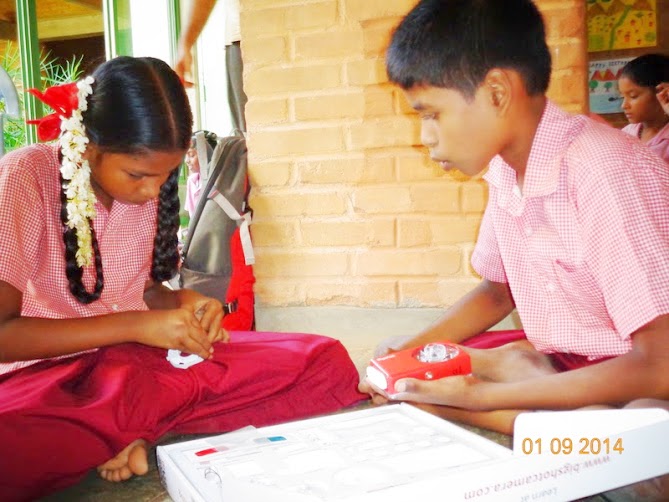
We also used physical technology primarily the DIY bigshot cameras that can be assembled by students and over 60 children from various grades assembled the cameras, took pictures and put them on the computer and then used instructions backwards to disassemble them for the next group to use them. The exercise of group work, reading and comprehending instructions and analyzing the pictures was interesting. The hand crank also gave a context to look into gears, ratios. A lot more could be done in optics, imaging. But, the children were very curious about the 3-D images taken by the camera and experimented quite a bit with depth.

The computer lab at Udavi, Makey, Makey, Bigshot cameras and the finch robot were donated by friends and visitors who saw the impact of technology on children and the interesting mathematics that the children were able to do. Further class notes and work of children is available at (www.smallisbeautiful.blogspot.com).

Just as the response of children to technology is obvious so is the lack of teachers who can play with this interesting resource and engage with children. This was especially true for teachers engaged with village children. As part of filling this gap I founded Aura Auro Design (www.auraauro.com) in collaboration with Aura Semiconductor Pvt. Ltd. this year. Aura Auro Design works with 3 electronics graduates and trains them in state of the art analog design (5 hrs a day) while engaging them for (3 hrs a day) to work with schools with a focus on learning through technology.
This has created a small team of local skilled and technically savvy youth who are learning and teaching at the same time. Aura Auro makes explicit that every teacher needs to be a learner.


It has also created a team that is working on STEM research in rural India to deliver results beyond what one person is capable of.

May 02, 2015

A year in pictures at Udavi School


Here are a few albums related for the 2014-15 schooling year at Udavi (primarily for the 6th grade), special thanks to Sudhir for the pictures. Click on the pictures to take you to the appropriate albums.

Electronics, makey, makey, battery and magnet based motors.

Makey Makey and water level detection.

Bigshot cameras (assembly, pics taken by the cameras, measuring the voltage of the pathway from the motors to the battery, etc).
6th Grade assembly

7th Grade assembly and pics taken

8th Grade assembly


8th Grade visit to crocodile park trip documented with the bigshot cameras they made

Puzzles and games and interaction with Aura Auro youth
.
Working with their hands on blocks and building models

Using wooden blocks to understand squares and square roots

End of the year demonstrations set up by children included demonstration of polarity of motors, games based on continuity, resistance (pencil lead extracted by burning out the wood at just the right temperature), makey, makey burgulary alarm. It also had the children perform about the plants in the solar system and build a rocket that moved.


April 20, 2015

If I had wings...

The work with the children in Udavi 8th Grade for their end of the year story called 'if I had wings' felt quite complete. I have already put a note on what I saw in the children when they were looking at their work and about their work itself.

Preparation: For the class project with the 8th graders on if I have wings we first set up the computers to be networked so they could save their data in one place. This helped us back up their files track their progress from one place.

Pairs: I noticed that the boys and girls don't seem to work much with each other and asked the boys and girls to pair up. I also asked them to plan what they wanted to accomplish as the time was short. They were also required to come up with quality criteria.

Day 1:  The class came up with the quality criteria to look at their projects through consensus:
Understandable,  Colorful, Creative, Beautiful, Proper Language, Interesting and Teamwork.

We also had the following agreements - discussion within the group is fine, but disturbing other groups is not ok. If technical assistance is needed you raise your hand. The classes had a little hum going like a bees bussing, but it never got too loud or noisy.

Sundar and I were providing support and we had asked the teacher also to join the children in making her own program.

The technical instruction of the day was on linking to the central computer and to Open and Save files over the network. This itself made a big difference to the children in the project. There appears nothing dampens enthusiasm as the possibility of destruction of your work and being able to build on their work gave them a sense of purpose.

Day 2: The children felt confident that they could get what they wanted to done and we opened up the space for them to access the internet and download images that they might find useful for their project and not limited to images in Scratch.

The instruction of the day was a demo of Gimp, contiguous selection which could help crop backgrounds quickly and help them use characters downloaded from the internet.

There was also instruction on not using the green start flag and using an event instead. All events were named with unique names by using the first two letters of both the children in the group. Similarly all sprites and backgrounds were named by adding the 4 letters to the end to avoid clashes when the programs were merged.

One of the groups went overboard and even named their character in their story the same name as their code names.

Day 3: To bring back focus on the project as some groups were drifting we had a session on feedback for growth. Each group watched what the next group had done and offered increase, decrease and retain feedback on the quality criteria.
There was some concern among us teachers that there is nothing to show yet.

Before the next class we looked at 2 groups who were really struggling and put a few lines of code giving them an idea of how to go about animating.

Day 4: They worked, we supported and kept shuttling around groups. 3 groups were satisfied with their work and called it done. 5 groups were not done.

We agreed to have a Day 5, but decided that the groups who were done would have to take it to the next level and start working on combining files with us.

Day 5: We started combining the files and came up with a much larger list of to dos in individual projects to make merging possible:
1) Append name of sprites, backgrounds with unique name for each group (we used the first two letters of the two children in each group)
2) Make each sprite hide  when the green flag is pressed
3) Each sprite is message driven and each message has the unique name followed by 1, 2, etc.
4) BG changes are also within the sprites (using change background)
5) Make the begin position of each sprite explicit

6) Hide when done

We were able to combine the three projects that were complete and we asked the children to go ahead and join the remaining groups supporting them through this code review and making the work of merging easier.

Day 6: We showed the children their combined work, they did a self assessment for themselves and we also did a survey for the children.

It was interesting to see quite a few children in the survey point to teamwork as a big learning for themselves another was getting what they set out to do done.


April 19, 2015

Wake up, Sanjeev...

Towards the end of the year I was invited by the English teacher at Udavi to do a session for closing the year with the 8th graders with making their stories in scratch.I had worked extensively with technology with the 7th graders for Math and this reflected in their abilities to program and create their stories in English, but a similar project with the 8th graders had not felt complete. She offered 4 classes (of 1 hr 20 min each) to get something whole done. The schedule was very tight and we went over what were our priorities they were to support children in their organization, concentration, determination to get their work done and teamwork. The theme of their work was 'if I had wings' and we wanted them to be able to dream and see it materialize.

The days flowed beautifully and we needed one extra day for 5/8 groups to complete and we working with the 3 group of students who completed to look at what it would take to merge the projects into one class project. The children started to look at reviewing the code to merge the projects.

The next class we looked at the combined project of all the children. It was a 4-1/2 minute animation that had no sound. We started watching the animation. About a minute into the animation I had a Wake up, Sanjeev moment. These are moments that you have when as a teacher something tells you to sit up and take notice about something happening in your class. I realized something magical was happening. The children were concentrating and looking at their work and the work of all their classmates as one drama. Children from the generation that have seen television at it loudest, flashiest and who are often seen as having too much noise were in full concentration in complete silence. Luckly, my wake up call came early enough for me to take a few photographs and then go ahead a record 40 seconds of the magic.

Here is the video of the children watching their work...


and here is their work:


Here is a note on the process we followed in the five days and how it was one of the times when things just flowed and fell in place.

December 20, 2014

English stories and their scratch avatars

Delivering a good English program is a challenge in most rural schools. To make it a creative exercise at Udavi children are asked to write their own stories. I have already been working with scratch with the 7th graders and with their English teacher we decided to give our time in the holidays for children interested to create their scratch avatars.

The creation of stories into scratch makes the children convert the story into a drama and they need to choose what they want to communicate through the characters and what they want to communicate through a narrator. It also allows for children to work at various levels from those who want to do elaborate animation to those who want only characters to talk alternatively. The aspects of logical thinking is highlighted and some children did have issues when they had more than two characters and they needed to track which character is speaking and how long the other characters need to hold their silence in order not to overlap.

A further complication was when the backgrounds and scenes changed and they needed to time these also right. This got further complicated if they changed the sequence and added a few seconds to read a specific text as all timings after that would change. A couple of students found their story too complicated to implement with timing and were able to learn and use the power of Scratch being an event driven programming language and broadcasted messages when certain events were complete to keep timing manageable even with a large number of characters.

One of the more elaborate stories involved a cat that made machines, got transformed into a half-cat and half-boy, saved the world from a monster, went to sleep and had a dream about an alien attack, then waking up and seeing the dream become a reality and then defeating the aliens. No really, the story exceeds my capacity to make things up:


The 8th grade tried to use the same two characters and have adventures that went to different places. One such story had a very elaborate backgrounds that were hand crafted by the student.


I tried to put a process of students typing in what they wanted to enter as conversation text in the hope that the spell checker will catch something for them and help them learn English. Unfortunately, in the excitement of making the program new dialogues were added and old ones removed resulting in a fair number of errors. However, by and large the idea that they were creating a sort of product was in the students mind and they also made a presentation to the coordinator of the school. Most children were happy that they had something to present.


About 80% of the class who came in the holidays and started the process were able to complete their projects. Here is one in which the child struggled to complete and put in extra time to complete the story.


November 02, 2014

Makey, Makey (4): Water level detection

With the 7th grade at Udavi I revisited the Makey, Makey a week later. I asked the ones who had used it earlier to demonstrate it to their friends who had missed it. The recall wasn't perfect and it gave a chance for them to debug.

Then we took it a step up and asked a different question, what application can we use the makey, makey for. Since it is able to detect the resistance of water we used it as a water level testing and then things got really interesting with them experimenting with their bodies in series with the water, etc.

Here is a video of the class that you can look at even if you have no clue what Makey, Makey is!


October 27, 2014

Makey, Makey – How it works...(3)

The day after the heavy rains we had an almost full strength in the 6th grade at Udavi. The previous day only seven children had worked with the MM and it felt like a good exercise in observation and expression to see how these children described what they had seen. Based on their descriptions I asked children to write or draw what they felt had happened.

All the pics from the ones who had not come had a computer (or laptop) connected to a leaf/plant and apparently running Scratch and making a sound. The children in their excitement to describe the plants, sticks, communicating with the computer had not been able to describe the MM. However, in their own drawings the MM was present as a black box.

We had a discussion of what we see and observe and what we understand and interpret. Once I pulled out the MM the children were able to recall most of what they had seen, but they could not talk about what they interpreted as to what happened initially. As I gave them time, one aspect of the MM sending signals to the computer was brought forward as something they had not seen, but interpreted based on the reaction of the computer and the lighting up of the board when we touched something. The other aspect of understanding how the board was able to detect that it had been touched was ambiguous.

We went to the computer lab and I gave a 'magic show' with making the MM board respond or not respond to my touching by saying it before hand. The children were very focused on what my hands were doing and whether I was touching the banana gently or not as gently, etc and did not notice that in the times I wanted the MM to respond I was touching my legs to the floor. Once I explained the trick I was able to lift my foot off the floor and use the wire provided to connect to the board with the same effect. Then I made it further simpler by bypassing everything and directly connecting the ground to one of the trigger points and then talking about how the circuit is being closed even by me.

We then discussed why we don't see the same in real life of connecting a battery with a LED and holding the two ends to light it. This brought forward the sensitivity of the MM to detect even not so good conductors. Then we moved to what we saw the previous day with respect to plastic and wood and that even their resistance can drop when things are wet.

We concluded with what precautions a lineman should take when working on main lines. The kid of clothes that he should wear especially when it rains.

I then did the same session with the 7th graders and was a little surprised that they were able to give all the signals given by the MM (space, click and four arrow keys). All their pictures highlighted MM and had it in this kind of detail. Thought when describing it in words they also cound not convey the MM. I then realized that since we have been working with scratch were able to understand not only that the MM sent some signals, but had perhaps read the code and noticed the signals.

I could, however, not pull the 'magic trick' on them. Almost immediately one hand went up and then within 10-15 sec three more went up on what I was doing with my foot. The loop closing made sense to the children and they went overboard asking me to use various chains of objects that would close the loop, e.g. touch this banana to the next, then to your keychain and then touch it.

We talked about possible uses of what we could do with a MM. The most common idea is a burglary alarm, but I'm hoping more ideas will come.

October 22, 2014

Makey all wet (2)

Monday morning, the rain had been very strong and I bicycled to Udavi and found many students were unable to make it. The new building had 6-7 kids in grades 4th, 5th and 6th. There were too few kids to take classes and I thought it would be a good opportunity to introduce the Makey, Makey (MM) board.

The MM board is able to integrate with real life objects (leaves, fruits, vegetables, plants) because of its ability to (measure very large resistances) be very sensitive to any resistive path. But, the sensitivity makes it misbehaves in the rain. It took me many attempts to figure out a mechanism to avoid a 'false' trigger. The wooden table that I wanted to use as base had imbibed some moisture and was itself triggering. We finally needed to hold the leaves and other material under test in the air.

When anyone touched the plant or leaf it would trigger scratch in producing a sound. As there were younger children I changed the sounds often. I also choose the sounds of animals (cats, dogs, etc) so the dog would bark when you touched the leaf, etc. The children were quite excited and I tried to tap into it to further inquiry.

What is happening? What do you see? What do you understand? What kind of objects will trigger the sound? We went from leaves, flowers, metal, to a stick of 'dry' wood, wooden blocks, and finally plastic! Everything triggered in the wet and moist conditions.

The plastic cap triggering was really a surprise, both for the children and for me and it was time to find a drier place. The rain then stopped and I took the 6th grade to the computer lab and was happy to find that the polished tables were able to present a dry environment where false triggers didn't happen.

The MM is able to close the circuit with a person without having to hold the earth wire (as indicated in the instructions) by using the floor and this makes thing appear more magical.

The class then continued with the 7th grade and we made a piano with bananas. The 7th graders have been working with Scratch and understood what was happening at a certain level of abstraction that they called the 'MM keyboard' vs the electronics keyboard that their program responded to.


October 03, 2014

Probability for 6th graders?

As an introduction to fractions the children were playing the pizza party game. They read the rules and the first game they played helps them get accustomed to the pieces (1/2, 1/3, 1/4, 1/6, 1/8). There are fraction sheets corresponding to each of the fractions as shown below.
The children throw a dice with these fractions on it, they pick up the fraction sheet that faces up. They then try to fill the sheet by waiting for their fraction to come up in their turn.

The game is of course terribly unfair for the children who get smaller fractions (and yet children do enjoy playing it), but I wondered if we could use this as an opportunity to see probability in action. I asked each child to write down the fraction (not person) who won the game in their group. Once the game was played a few times I made a tally of how frequently a fraction won.


As each student read our her/his findings it soon became clear that most of the time 1/2 was winning, once in a while 1/3 won and very infrequently 1/4 won. With these rules 1/6 and 1/8 did not win any games played. 

We had a conversation of whether the rules were fair to each fraction. Then we moved to the question of why it is not fair. It was nice that some of the children were able to think this through. The first child who got it said that its because 1/8 fraction needs 8 pieces and you need to get 1/8 8 times, vs 1/2 where you only need to get 1/2 2 times. Getting something two times is 'easier' than getting something 8 times. In a few minutes most children were also giving their explanations along the same lines.

I proposed a different set of rules for the next game to try to help the 1/6 and 1/8 (and get them comfortable with equivalent fractions). If you get any piece that lines up with the lines on your sheet you can take that many pieces i.e. on a 1/8 fraction sheet, if you roll 1/2 you can take 4 pieces, if you roll 1/4 you can take 2 pieces and if you roll 1/8 you can take one piece. But, if you roll 1/3 or 1/6 you need to pass. I asked if this set of rules would even the odds...the children were unsure so we went for a few rounds of the game with the new rules.


We had just enough time to come together and tally the results. 1/8 followed by 1/6 were the most common winners, 1/4 was next followed by 1/2. 1/3 was the least common fraction to finish first.

I asked them to think up game rules that would both be interesting and fair to the fractions. A couple of days later, they came up with some games. Some of the games  proposed were repeats (apparently arrived at independently). I asked the children to rate the games in two parameters, their interest in playing the game and if they thought the game was fair. 

Game 1: Like the first game, but you can take a piece of your fraction even if you get a nearby fraction e.g. 1/6 for 1/8. 
Q & A: What about 1/3 & 1/2? Yes you can take these pieces as well.
Interesting - 13, Fair - 1

Game 2: Have all pizza common, you place the fraction you get. The person who finishes a pizza first wins.
Interesting - 11, Fair - 8

Game 3: Like first game, but if you get a fraction you can't use, you give it to another person who has that card.
Interesting - 11, Fair - 11

Game 4: You just need to make a full pizza based on whatever your dice gives.
Interesting - 14, Fair - 10

Game 5: You can give and take pieces from others. 
Q & A: On what basis? Not clear, it needs to be figured out. (Calvin Ball!)
Interesting - 16, Fair - 6

5 children were not participating in the fair/not fair question as they were in doubt, but a large number of the remaining were able to guess that 1 was unfair; 2 was fair (to people); got tricked in 3 because it seemed that you were being nice (so it must be fair!); that 4 is fair. I am unclear about the rules of 5, clearly the children found the lack of clarity appealing :), but were less sure of its fairness!

Need to update this blog when we play the games again.