Recent Popular Posts

April 25, 2007

On my way to Navadarshanam

I started out for Navadarshanam around 10 AM on a Monday morning and it didn’t take me long to realize what a blunder that was! I was hoping to ride the bus to Majestic (the bus terminal in Blore) and then catch a bus to Anekal. There was no way I could squeeze in with my two bags, well, at least I didn’t want to try it. Found an auto after some time and he told me it was much easier to take the bus to Anekal from the Silkboard – much closer. The bus to Anekal came along pretty soon and in about 50 minutes, we reached Anekal. I took an auto from there to Gumalapuram, where Navadarshanam (ND) is located.

I had heard about ND from Anita B and then from some Asha Bangalore volunteers. In fact, when I asked Gaurav’s mom where to get the awesome dalia I had at their place, she took me to Namdharis. I was very surprised to see it was a Navadarshanam product. They supply a few wholesome products like red rice, sprouted dalia and ragi to the Namdhari chain of stores in Bangalore. Their website has quite some information - they seemed to be trying out some alternatives in housing, energy and living and I got curious. I called ND about staying there for 4-5 days and Jyothi said it wouldn’t be a problem.

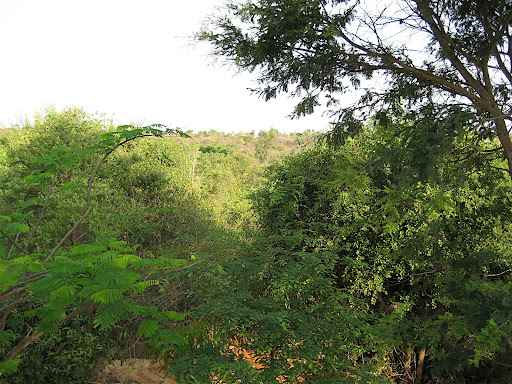
I reached ND around 1:30 and there were about 10-12 people having their lunch. I joined them and kicked off my stay with ragi muddai and some tasty sauce. Jyothi and Ananthu had gone to Blore and would only return at night. I was taken to my room in Manjari and I spent the entire afternoon in the balcony reading. The balcony overlooks an expanse of greenery and there’s always a breeze blowing. Around 5 in the evening, it got very pleasant and I went out for a walk. The ND trust looks after about 105 acres of land and I stumbled upon various paths. I was finally pointed to the periphery road, which is 2.5 – 3 km long. I walked some distance, deciding to put my running shoes to use here the next morning. Watched a beautiful sunset and walked back for dinner. Just as I was finishing my dinner, Om, Ananthu and Jyothi got there. After some introductions, we decided to get together the next morning to talk about what I was doing there.

March 08, 2007


The Thulir Experience
About Sittilingi
About Anu and Krishna
How we landed at Thulir
Porting Sugarcane
Interacting with children in technology course
Home schooled children
First evening class: Getting children to make their own puzzles
Learning Circuits (LC) I: Let there be (some) light
An early morning visitor
They were not kidding
LC II: A different approach
LC III: Taking stock & roofing
LC III(a) My homework: making a torch
LC IV: Checking components
Group Discussion: Fear
LC V : Building boards and getting to know the boys better
LC VI: Testing and fixing
Pictures from Thulir
Thulir Blog

How we landed at Thulir

How we landed at Thulir

We heard about Anu and Krishna through Asha. They are both Asha fellows and we learnt more about what they were doing on a conference call in which Krishna spoke. We were interested not only in their work in alternate education but also in their trying to lead a more organic life - Krishna had briefly mentioned solar panels and dry composting toilets and we wanted to learn more.

We had moved to India with an idea of spending time with a few grassroots efforts. Thulir happened almost suddenly. We had a bunch of weddings to attend and after a couple of weddings and a few trips to different urban spaces; we were starting to get restless. We then contacted Anu and Krishna to check if they would be willing to have us over for about 10 days. They quickly figured out where to put us up and in a few days we were traveling to Sittilingi.

Getting to Sittlingi
Feb 12

We started from Chennai at 4:00 am, so we could reach Sittilingi by 2:00pm. The plan was to get to Tiruvannamalai in time to catch the 10:30 a.m. bus that goes all the way to Sittilingi. The only other bus was at 3:30 p.m. so we had no intention of missing this bus J. We first went to Kottapatti (CMBT bus terminal) to catch the out-station bus (platform 6) and reached by 9:00 a.m. with plenty of time to spare for our connecting bus. We had iddli, dosa and coffee at Ashoka Hotel and reached Sittlingi by 2:00 p.m. We got of at the Tribal Health Center (called the Sittlingi Hospital stop). We mentioned Thulir and were led to the center of the hospital from where we were driven a few km to Tulir. Krishna was at the gate to greet us. Funny as it was, the call taxi to take us to Kottapatti cost us more than breakfast and the rest of the journey.

About Anu and Krishna

History: Anu and Krishna are both architects and have worked for a long time in constructing houses in rural areas. We enjoyed talking to them about how they got interested in this field. 1988 was declared as the year of homes for the homeless (by the UN I think) and the theme for the annual architects meet was decided to be the same topic in 1987, in order to prepare for the main conference the next year. This exposed many of the students to the problems faced in the slum and rural areas and encouraged them to think about constructing houses using local materials etc. Anu and Krishna were deeply influenced by this conference and since then, they have been working with different NGOs, first with Gandhigram near Madurai and then with a group near Gudalur. Gandhigram has many cottage industries. They both worked on mud houses there. At Gudalur, they worked on teaching the tribals construction methods. Their goal was to make them self-reliant in some skills and to eventually empower the tribals so that their (Anu and Krishna) presence would not be needed. They worked with children who had dropped out of school and later, also spent time teaching younger children. They trainees were able to do estimating, draw out plans and analyze costs. How did they come to be at Sittilingi? Anu and Krishna’s friends, Regi and Lalita, doctors by profession, decided to move here in 1992 – 1993 since the place had poor human development statistics. They set up a hospital, called Tribal Health Initiative. Anu and Krishna were interested in working with the children in this area. After a year of travel to various such efforts in India, they moved to Sittilingi in 2003 - 2004 and Thulir was started.

About Sittilingi - Anita

Sittilingi is located in a beautiful valley, surrounded by hills on all the four sides. It is one of the villages in the valley and the population of the valley is about 10,000. The place was difficult to access till about 6 months back when a road was laid connecting it to Salem. Most of the people native to Sittilingi belong to the Lambadi or the Malayali tribes, the latter name derived since the valley is surrounded on all sides by hills, ie, “malai” in Tamil. Most of the people own some land, which is because of their tribal chieftain who handed over land pattas to the natives and registered them as Tribals when Sittilingi was made part of India. The main occupation here is agriculture. Until about 2 years back, people practiced subsistence agriculture. People grew their own food and perhaps the excess was sold in Kottapatti, the nearest market and Salem. Also the methods used were sustainable compared to mainstream agriculture – organic methods were employed and people did not engage in unseasonal irrigation. Only recently, with the connection to Salem and thus a market, they have been growing more cash crops and using chemical pesticides and fertilizer. Sugar cane is one of the cash crops grown here - we saw a few tractor-loads of it leaving for the market. They also grow turmeric and cotton. They also grow industrial tapioca which industries use for starch. Most of the tribals grow tapioca and turmeric. The tribals who have dug wells and use pumps are the ones growing sugarcane, the rest do not due to the amount of water sugarcane requires. Sittilingi does not have any active market. We wanted to purchase some fruits but all we could find in a makeshift shop cum rudimentary hotel were a bunch of bananas, whereas one would find local farms growing papayas and guavas!